695 - Max Area Of Island
#medium
You are given an m x n binary matrix grid. An island is a group of 1's (representing land) connected 4-directionally (horizontal or vertical.) You may assume all four edges of the grid are surrounded by water.
The area of an island is the number of cells with a value 1 in the island.
Return the maximum area of an island in grid. If there is no island, return 0.
Example 1:
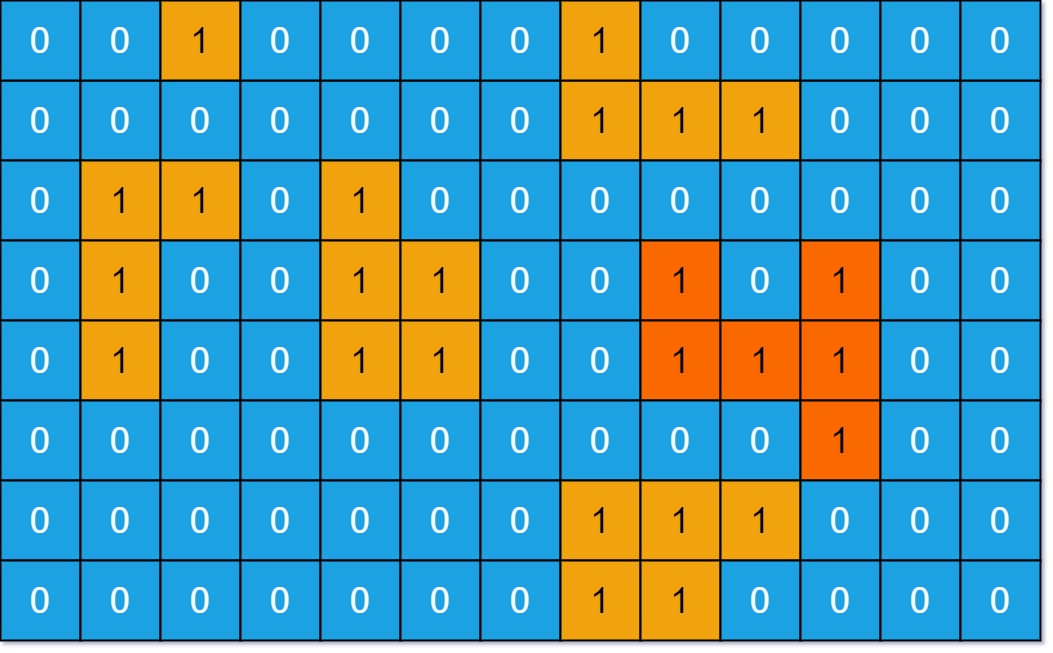
Input: grid = [ [0,0,1,0,0,0,0,1,0,0,0,0,0],[0,0,0,0,0,0,0,1,1,1,0,0,0],[0,1,1,0,1,0,0,0,0,0,0,0,0],[0,1,0,0,1,1,0,0,1,0,1,0,0],[0,1,0,0,1,1,0,0,1,1,1,0,0],[0,0,0,0,0,0,0,0,0,0,1,0,0],[0,0,0,0,0,0,0,1,1,1,0,0,0],[0,0,0,0,0,0,0,1,1,0,0,0,0] ]
Output: 6
Explanation: The answer is not 11, because the island must be connected 4-directionally.
Example 2:
Input: grid = [ [0,0,0,0,0,0,0,0] ]
Output: 0
class Solution {
public:
    int dfs( vector<vector<int>> & grid, int m, int n, int i, int j ) {
        if ( i < 0 || i >= m || j < 0 || j >= n || grid[i][j] == 0) {
            return 0;
        }

        grid[i][j] = 0;
        int left = dfs( grid, m, n, i - 1, j );
        int right = dfs( grid, m, n, i + 1, j );
        int up = dfs( grid, m, n, i, j - 1 );
        int down = dfs( grid, m, n, i, j + 1 );
        return ( left + right + up + down ) + 1;
    }

    int maxAreaOfIsland(vector<vector<int>>& grid) {
        int result = 0;
        int m = grid.size();
        int n = grid[0].size();
        for ( int i = 0; i < m; i++ ) {
            for ( int j = 0; j < n; j++ ) {
                if ( grid[i][j] != 0 )
                    result = max( result, dfs( grid, m, n, i, j) );
            }
        }

        return result;
    }
};