129 - Sum Root To Leaf Numbers
#medium
You are given the root of a binary tree containing digits from 0 to 9 only.
Each root-to-leaf path in the tree represents a number.
- For example, the root-to-leaf path
1 -> 2 -> 3represents the number123.
Return the total sum of all root-to-leaf numbers. Test cases are generated so that the answer will fit in a 32-bit integer.
A leaf node is a node with no children.
Example 1:
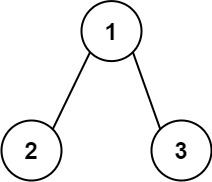
Input: root = [1,2,3]
Output: 25
Explanation:
The root-to-leaf path1->2represents the number12.
The root-to-leaf path1->3represents the number13.
Therefore, sum = 12 + 13 =25.
Example 2:
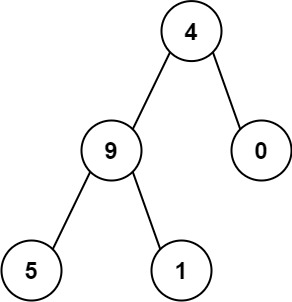
Input: root = [4,9,0,5,1]
Output: 1026
Explanation:
The root-to-leaf path4->9->5represents the number 495.
The root-to-leaf path4->9->1represents the number 491.
The root-to-leaf path4->0represents the number 40.
Therefore, sum = 495 + 491 + 40 =1026.
Constraints:
- The number of nodes in the tree is in the range
[1, 1000]. 0 <= Node.val <= 9- The depth of the tree will not exceed
10.
/**
 * Definition for a binary tree node.
 * struct TreeNode {
 *     int val;
 *     TreeNode *left;
 *     TreeNode *right;
 *     TreeNode() : val(0), left(nullptr), right(nullptr) {}
 *     TreeNode(int x) : val(x), left(nullptr), right(nullptr) {}
 *     TreeNode(int x, TreeNode *left, TreeNode *right) : val(x), left(left), right(right) {}
 * };
 */
class Solution {
public:
    vector<int> path;
    void traversal( TreeNode * root, int & result ) {
        path.push_back( root -> val );
        if ( root -> left == NULL && root -> right == NULL ) {
            int temp = 0;
            for ( int i = 0; i < path.size(); i++ ) {
                temp = temp * 10 + path[i];
            }

            result += temp;
            return;
        }

        if ( root -> left ) {
            traversal( root -> left, result );
            path.pop_back();
        }
        if ( root -> right ) {
            traversal( root -> right, result );
            path.pop_back();
        }
    }

    int sumNumbers(TreeNode* root) {
        int result = 0;
        traversal( root, result );
        return result;
    }
};